
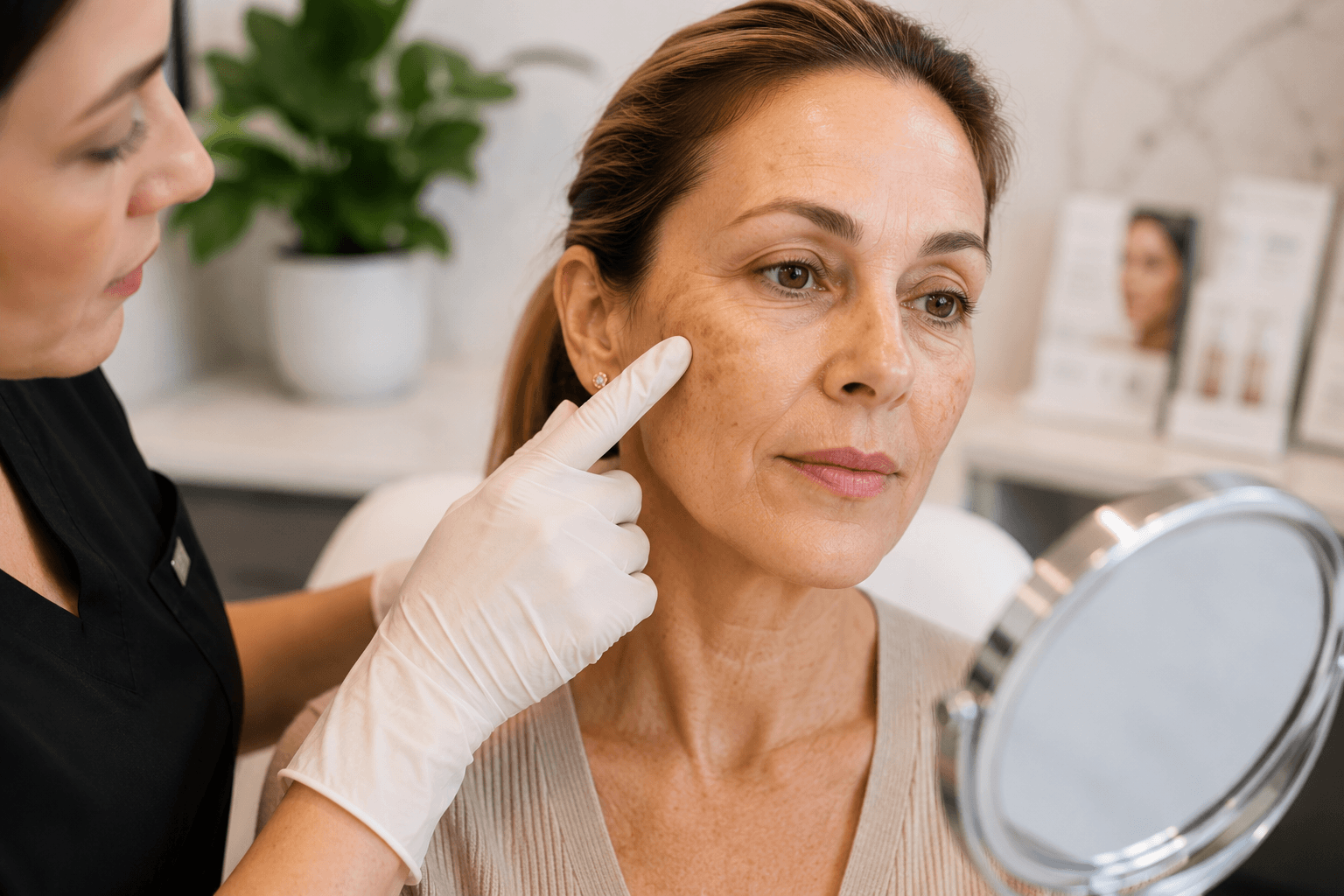
At some point, most people start noticing small brown or tan patches showing up on their face, hands, or chest that were not there a few years earlier. The instinct is usually to call all of them the same thing, age spots, liver spots, sun spots, and assume any dark spot treatment will handle them equally well. That assumption is where a lot of frustration and wasted money starts.
The truth is that "dark spots" is an umbrella term covering several genuinely different conditions, each caused by a different process in the skin, and each responding best to a different treatment approach. Getting the diagnosis right before choosing a treatment is the difference between real improvement and months of a product or procedure that was never going to touch your specific type of spot.
Are Age Spots and Liver Spots the Same Thing?
Yes, functionally they are. "Age spots" and "liver spots" are two common names for the same condition, medically known as solar lentigines. Despite the name, they have nothing to do with liver function or health, that association is an old myth. They are flat, tan to dark brown spots caused by cumulative sun exposure over years, most commonly appearing on the hands, face, shoulders, and chest, areas that get the most lifetime UV exposure.
What Is the Difference Between Age Spots and Melasma?
This is where the confusion usually starts. Age spots, or solar lentigines, are typically well defined, small, individual spots caused by direct cumulative sun damage over time. Melasma, by contrast, tends to appear as larger, more symmetrical patches, often across the cheeks, forehead, or upper lip, and is driven primarily by hormonal factors, commonly pregnancy, birth control, or hormone therapy, with sun exposure acting as a trigger that worsens existing melasma rather than the root cause.
The distinction matters clinically because melasma is notoriously sensitive to aggressive treatment and can actually worsen with certain lasers or peels if not approached carefully, while typical age spots generally respond well and predictably to a wider range of treatments.
What Is Post Inflammatory Hyperpigmentation, and How Is It Different?
Post inflammatory hyperpigmentation, often shortened to PIH, is dark discoloration that develops after some kind of skin injury or inflammation, such as a healed acne breakout, a cut, a rash, or even irritation from a harsh skincare product. Unlike age spots, PIH is tied to a specific triggering event and tends to fade on its own over months, though it can be sped up with the right treatment. Unlike melasma, it is not hormonally driven and typically does not follow the same symmetrical pattern across the face.
Why Does Erie's Climate Matter for Dark Spots?
Erie's lake effect weather creates a seasonal pattern that actually affects pigmentation more than people expect. Summers along Lake Erie bring plenty of sun exposure, including reflected UV off the water, which accelerates the formation of solar lentigines and can worsen existing melasma. Winters, while overcast, still carry UV exposure, especially with reflection off snow, which is a commonly underestimated source of cumulative sun damage for skin that people assume is "protected" simply because it is cold outside.
This seasonal pattern is part of why so many Erie clients notice their dark spots becoming more visible after summer and are eager to treat them heading into fall and winter, when a treatment plan can proceed without worrying about immediate re-exposure to strong summer sun.
How Do You Actually Treat Each Type of Dark Spot?
Solar lentigines, the classic age or liver spots, generally respond well to a range of treatments including chemical peels, IPL photofacial, and targeted laser treatments like our melasma and Spectra laser service, which uses concentrated light energy to break down excess pigment in a specific spot.
Melasma requires a more cautious, layered approach, often starting with diligent daily sun protection and gentler topical routines before considering procedures, since overly aggressive treatment can trigger a flare rather than an improvement. When procedures are used for melasma, they are typically approached more conservatively and monitored closely.
Post inflammatory hyperpigmentation often improves with time alone, but can be meaningfully accelerated with treatments like chemical peels, which encourage skin cell turnover and help fade residual discoloration faster than waiting it out.
Can a Chemical Peel or Laser Make My Dark Spots Worse Instead of Better?
It can, if the wrong treatment is matched to the wrong type of pigmentation, which is exactly why an accurate assessment before treatment matters so much. Melasma in particular can worsen with treatments that are too aggressive or not followed by strict sun protection afterward, since the underlying hormonal drivers are still present regardless of the procedure performed. This is not a reason to avoid treatment altogether, it is a reason to have an experienced provider correctly identify what you are dealing with first.
How Long Does It Take to See Improvement in Dark Spots?
This varies significantly by type. Solar lentigines often show noticeable fading within a few weeks of an appropriate laser or peel treatment. Melasma tends to require a longer, more gradual approach measured in months rather than weeks, with ongoing maintenance to prevent recurrence. Post inflammatory hyperpigmentation typically fades over one to several months depending on how deep the discoloration sits and whether treatment is used to accelerate the process.
Getting the Right Diagnosis Before the Right Treatment
If you have tried a dark spot serum or a random peel with no results, it is worth considering that the product may simply not have been designed for the type of pigmentation you actually have. A proper skin assessment identifies which category your spots fall into before recommending next steps, which saves both time and money compared to guessing.
Explore our hyperpigmentation concern page to see the range of treatments available, or learn more about our melasma and Spectra laser treatment and chemical peel menu at Rejuv Medspa. You can also visit our IPL photofacial page to learn about another common option for sun related discoloration, or head to our homepage to schedule a consultation in Erie, Pennsylvania.
Spot On: Wrapping Up the Confusion
Not all dark spots are created equal, and treating them like they are is the fastest way to waste time and money on the wrong approach. Once you know whether you are dealing with sun driven age spots, hormonally driven melasma, or injury related PIH, choosing the right treatment becomes far more straightforward. This guide was updated in July 2026 to reflect current diagnostic and treatment approaches at Rejuv Medspa.
Frequently Asked Questions
Are age spots and liver spots dangerous? No, age spots and liver spots (solar lentigines) are harmless, though any new or changing spot should be evaluated to rule out other skin conditions, since some skin cancers can resemble benign pigmentation.
What is the difference between age spots and melasma? Age spots are small, well defined spots caused by cumulative sun exposure, while melasma appears as larger, symmetrical patches driven primarily by hormonal factors, with sun exposure acting as a trigger rather than the root cause.
Can chemical peels remove age spots? Yes, chemical peels are commonly used to fade solar lentigines by encouraging skin cell turnover, though melasma requires a more cautious, layered treatment approach.
Why do my dark spots get worse in the summer? Sun exposure, including reflected UV off water, accelerates the formation of new solar lentigines and can worsen existing melasma, which is why many people notice more visible discoloration after summer.
How long does it take to fade dark spots with treatment? Solar lentigines often show improvement within a few weeks of treatment, while melasma typically requires a longer, more gradual approach measured in months with ongoing maintenance.
.webp)